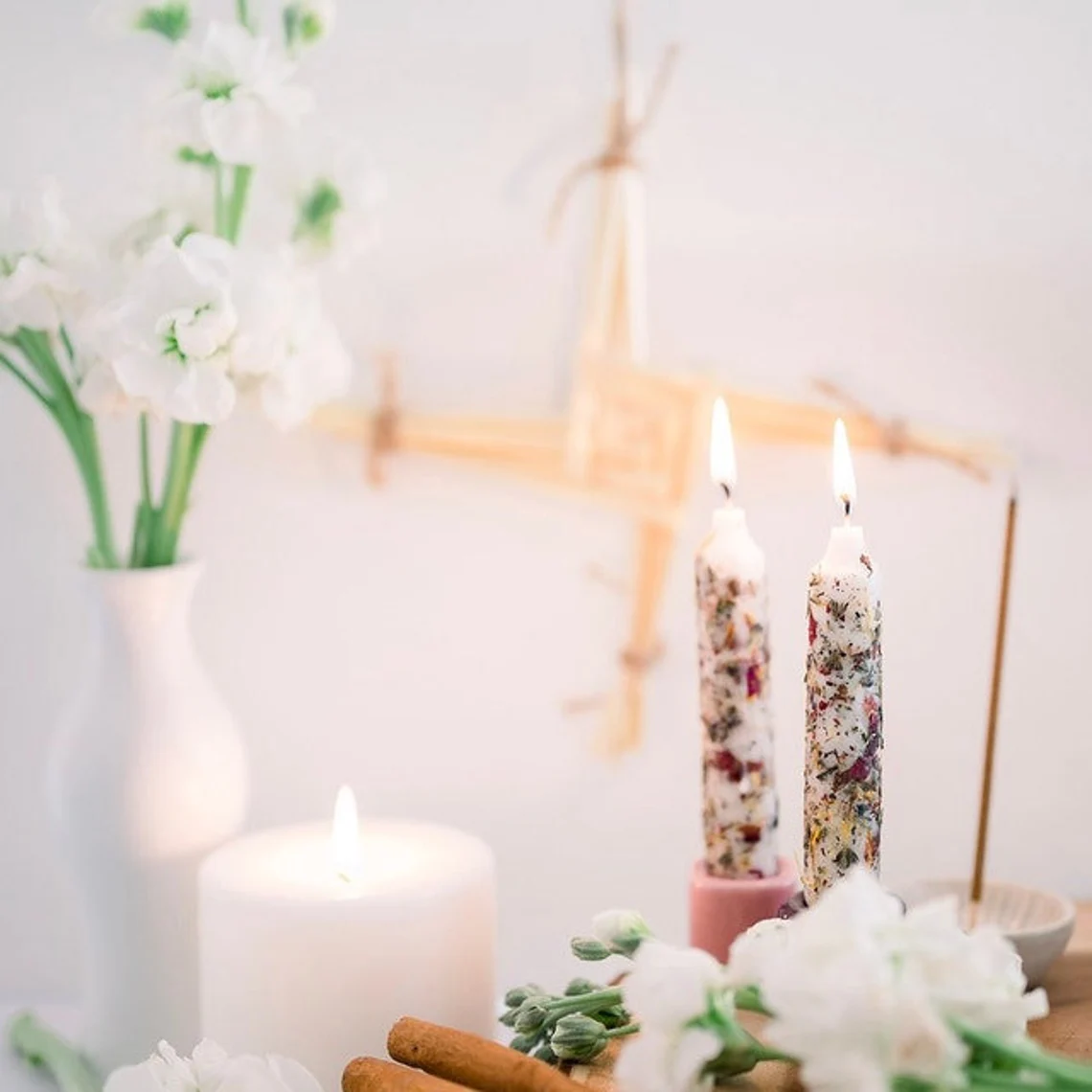
Setting a Daily Altar Ritual with Herbal Chime Candles
There’s a particular kind of chaos that builds up in a room over a week — mail piled on a surface, half-finished cups of tea, the general residue of a life being lived quickly. Most of us never notice it until we sit down to actually be still, and suddenly the clutter feels loud. Before you can set an intention for your day, you have to clear a space for it — literally.

Why the Physical Space Matters More Than You Think
It’s tempting to think of ritual as something purely mental — a mindset you switch into wherever you happen to be. But intention-setting works best when it has a place. A dedicated altar space, even a small one, does something practical: it trains your nervous system to associate that spot with stillness. Over time, sitting down in front of it becomes a cue, the way a certain chair might cue you to read, or a particular mug might cue you to slow down. You don’t need a dedicated room or an elaborate setup. A small table, a shelf corner, even a windowsill can work.
What matters is:
- It’s cleared of unrelated clutter. Bills, chargers, and to-do lists don’t belong in this spot — their presence pulls your attention back into obligation.
- It’s used consistently. The same spot, ideally around the same time each day, builds the association faster than a different spot every time.
- It holds only what supports the ritual. A candle, maybe a small object with meaning to you, and nothing else competing for attention.
Once the space is clear, you need something to mark the beginning of the ritual — a signal that tells your mind, “we’re switching modes now.” This is where a candle becomes more useful than almost anything else you could put on that shelf.
Why a Candle Is the Ideal Time-Bound Tool
A candle does something a phone timer or a mental note can’t: it gives your intention a physical, visible container. When you light it, you’re not just starting a ritual — you’re watching time made visible. The flame is a promise with a built-in endpoint. You know, without checking a clock, that this practice has a beginning and it will have an end, and that structure alone makes it easier to actually sit still instead of wondering how much longer you “should” meditate.
This is specifically why a chime taper — a slim, quick-burning candle — works better for a daily practice than a large pillar candle. A chime candle burns for roughly 60 to 90 minutes total, but even a short session of 10–15 minutes gives you a visible marker: the wax has dropped, the flame has been present, something has happened. It’s sized for a daily habit, not a one-time event — you’re not committing to babysit a candle for hours, and you’re not left with a half-burned pillar guilt-tripping you from the shelf.
Our Handmade Herbal Soy Chime Tapers are built with exactly this rhythm in mind. Each one is dressed with botanicals by hand — dried herbs and flowers pressed into the soy wax — so that lighting it engages more than sight. There’s scent as the herbs warm, texture in the visible botanical dressing, and the soft, steady burn quality that soy wax is known for. It becomes a small multi-sensory anchor for the same two or three minutes each day, which is often all a beginner’s ritual needs to actually stick.
A Simple Way to Begin
If you’re new to this, you don’t need a script. Try this:
- Clear your small space — just the surface where the candle will sit.
- Light the chime taper and take three slow breaths as the flame settles.
- Name one intention for the day, silently or out loud — a word, a feeling, a single sentence.
- Sit with the candle for as long as feels natural. There’s no required minimum.
- When you’re ready to move on, either let the taper burn down (it’s sized for this) or extinguish it gently, knowing you’ll return to that same space tomorrow.
That’s the whole anatomy of it: a cleared space, a small flame, a few minutes of attention. The ritual doesn’t need to be bigger than that — it just needs to be repeated.